 ドンチュアンウル


お客様のご要望をお送りいただければ、24時間以内にご連絡いたします。
Collapsible Export Crates: How Flat-Pack Design Cuts Shipping Costs
For companies that ship heavy machinery, industrial equipment, or fragile goods overseas, export packaging is often an overlooked line item in the logistics budget. Yet for many exporters, the cost of getting empty crates to the factory — and fully packed crates to the port — can quietly eat into already-thin margins.
Collapsible export crates (also called flat-pack crates または knock-down crates) are changing that equation. In this article, we explain how flat-pack crate design works, and why more exporters are switching from traditional fixed wooden crates to collapsible solutions.
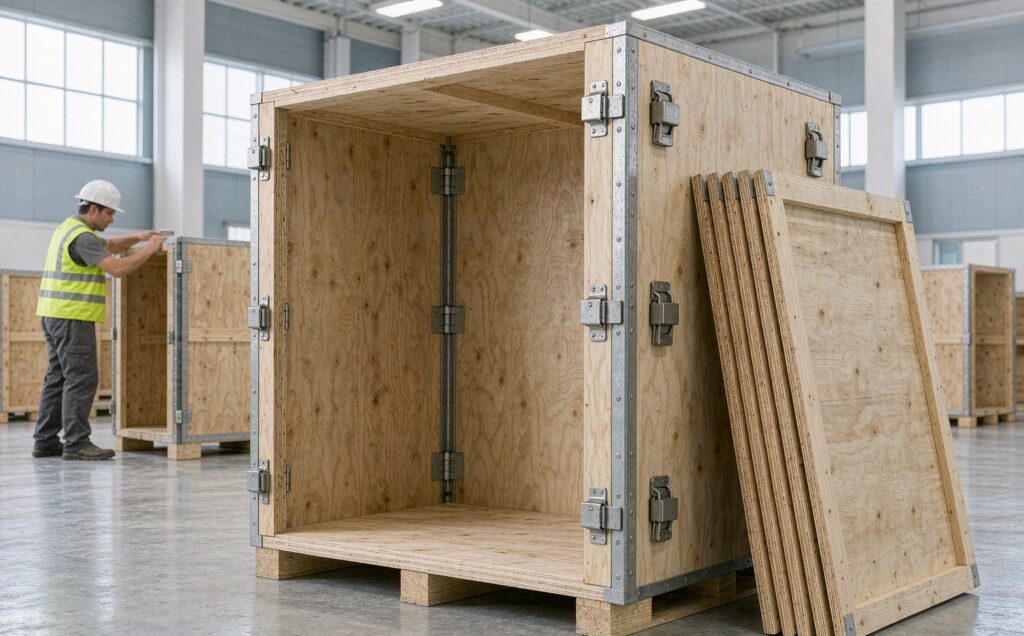
A collapsible export crate: the same panels that form a full-size crate fold down flat for storage and transport.
The Hidden Cost of Traditional Wooden Export Crates
A traditional export crate arrives at your facility fully assembled. That sounds convenient — until you consider what you are actually paying to ship: mostly air.
A standard assembled wooden crate occupies its full volume whether it is empty or full. When a supplier delivers 50 empty crates to your factory, those crates fill several truckloads of space. The same applies in reverse: if you are a crate manufacturer shipping packaging to your customers, every empty crate consumes the same container space as a full one.
The costs show up in three places:
- Inbound freight — moving empty crates from the crate maker to your plant.
- Storage — assembled crates occupy warehouse floor space at a 1:1 ratio with their working volume.
- Return or disposal — many one-way crates are discarded after a single trip, adding waste-handling costs at the destination.
How Flat-Pack Crate Design Cuts Shipping Costs
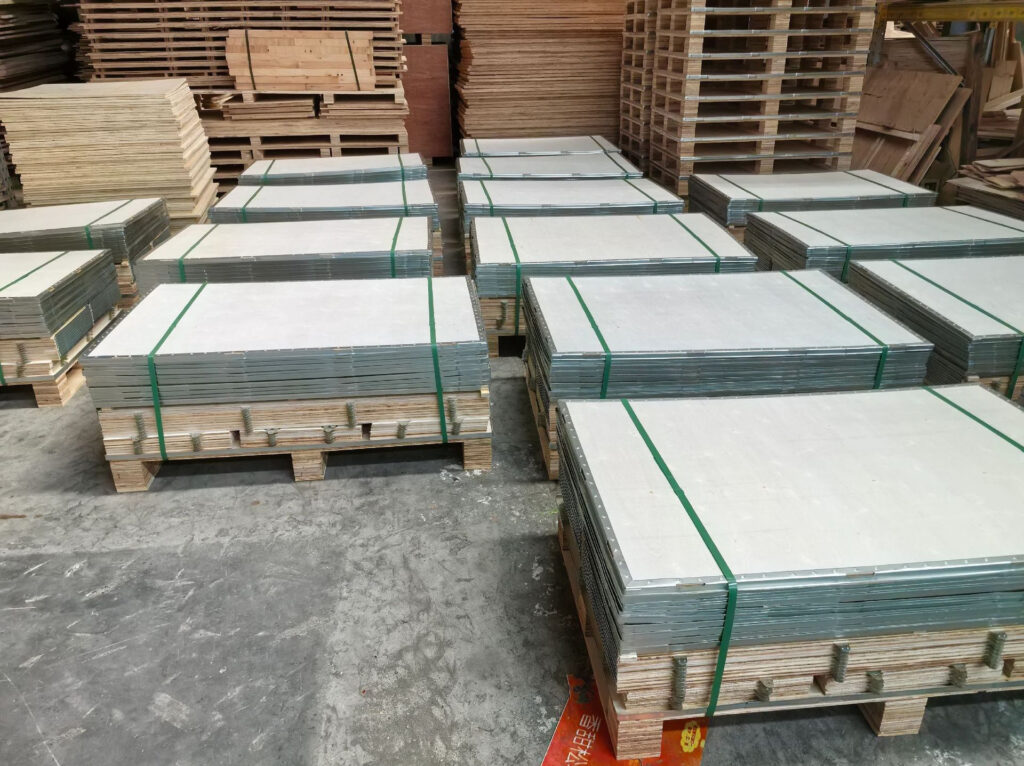
A collapsible crate is engineered so that its walls, base, and lid can be folded or disassembled into a compact flat bundle. Depending on the design, 5 to 8 collapsed crates occupy the space of a single assembled one — a volume reduction of 70–85%.
1. Lower freight cost per crate
Because collapsed crates stack flat, a single 40-foot container can carry several times more flat-pack crates than assembled ones. The freight cost is spread across more units, dramatically reducing the per-crate transportation expense. For exporters shipping packaging internationally, this alone can cut inbound logistics costs by 40–60%.
A 40ft container loaded with flat-pack crates: hundreds of collapsed units fit in the space of a few dozen assembled ones.
2. Less warehouse space
Flat bundles can be stored vertically on racks or stacked on pallets. A warehouse that previously held 200 assembled crates can now hold over 1,000 collapsed ones — freeing up floor space for revenue-generating inventory instead of idle packaging.
3. Faster, tool-free assembly
Modern collapsible crates use clip systems, tongue-and-groove panels, or quick-lock steel fittings. A single worker can typically assemble one crate in 1–3 minutes, without nails, screws, or specialized tools. This reduces labor cost at the packing station and eliminates the injury risk associated with nail guns and hammers.
4. Reusable shipping crates and return logistics
Because the crates fold flat again after use, returning them is finally economical. Many companies now run closed-loop programs with their customers or overseas branches: the recipient folds the empty crate, stacks it, and ships it back at a fraction of the original freight cost. A durable collapsible crate can complete 5–10 round trips, spreading its purchase cost over many shipments.
5. ISPM 15 compliance built in
Quality collapsible export crates are manufactured from heat-treated (HT) or fumigation-free materials such as plywood and OSB, which comply with ISPM 15 international phytosanitary standards. That means no fumigation certificates, no customs delays, and no risk of cargo rejection at the destination port.
Real Numbers: Cost Comparison of Fixed vs. Collapsible Export Crates
| Cost Item | Traditional Fixed Crate | Collapsible Flat-Pack Crate |
| Container capacity (40′ HQ) | ~60 assembled units | ~300–400 flat units |
| Freight cost per crate | High (shipping air) | Reduced by 40–60% |
| Warehouse footprint | 1× working volume | 1/5–1/8 of working volume |
| Assembly time | 15–30 min (nailing) | 1–3 min (tool-free) |
| Typical lifespan | 1 trip | 5–10 round trips |
| ISPM 15 compliance | Requires HT/fumigation | Exempt (plywood/OSB) |
Figures are representative; actual results vary by crate size and design.
Who Benefits Most from Collapsible Export Crates?
Flat-pack crates deliver the strongest ROI for:
- Machinery and equipment exporters shipping heavy, high-value goods on recurring routes
- Automotive and aerospace suppliers with closed-loop supply chains
- Trade show and exhibition logistics, where crates must travel out and back
- Any company paying to ship, store, or return empty packaging over long distances
FAQ
What is a collapsible export crate? A collapsible (flat-pack or knock-down) crate is an export packaging box whose panels fold or disassemble into a flat bundle for shipping and storage, then reassemble quickly without tools.
Are collapsible crates strong enough for heavy machinery? Yes. Industrial-grade flat-pack crates made from plywood, OSB, or engineered lumber with steel locking fittings are rated for heavy machinery and equipment exports.
Do collapsible crates meet ISPM 15 export requirements? Crates made entirely of plywood, OSB, or other manufactured wood are exempt from ISPM 15 heat-treatment requirements; solid-timber versions must be heat-treated and stamped.
How much can flat-pack packaging really save? Most exporters see 40–60% lower freight costs on empty packaging movement and 70–85% less storage volume. Multi-trip reuse compounds the savings.
結論
Shipping air is expensive. Collapsible export crates attack the problem at its source: by folding flat when empty, they cut freight volume, warehouse space, assembly labor, and waste — all at once. For exporters facing rising logistics costs and tightening margins, flat-pack packaging is one of the simplest operational upgrades with a measurable, immediate payback.
Looking to reduce your export packaging costs? Contact us for a free consultation and a customized flat-pack crate solution for your products and shipping routes.